Pelvic Girdle Pain
Prenatal with Jaimi

The short version: Pelvic girdle pain in pregnancy follows a predictable pattern — already-softened joints carrying more weight than they should because a growing belly and shifting center of gravity is triggering an adaptation that puts pressure on those joints. You can't change the hormones. But you can change how your pelvis is organized in relationship to the weight it's carrying — and that takes awareness and a bit of deep core connection.

If you're pregnant and you're feeling pain in the front of your pelvis — or deep in your hips and lower back — there's a good chance you're dealing with some kind of pelvic girdle pain.
It's common, but you don't have to suffer through it.
First, a quick distinction
Pelvic girdle pain is an umbrella term. It covers pain in the joints of the pelvis — the sacroiliac joints at the back, the pubic symphysis at the front, or both.
SPD — symphysis pubis dysfunction — is a specific type of pelvic girdle pain. It refers to pain and instability at the pubic symphysis: the joint at the front center of your pelvis.
Because the pelvis is essentially a ring of bone, what affects one part affects the rest
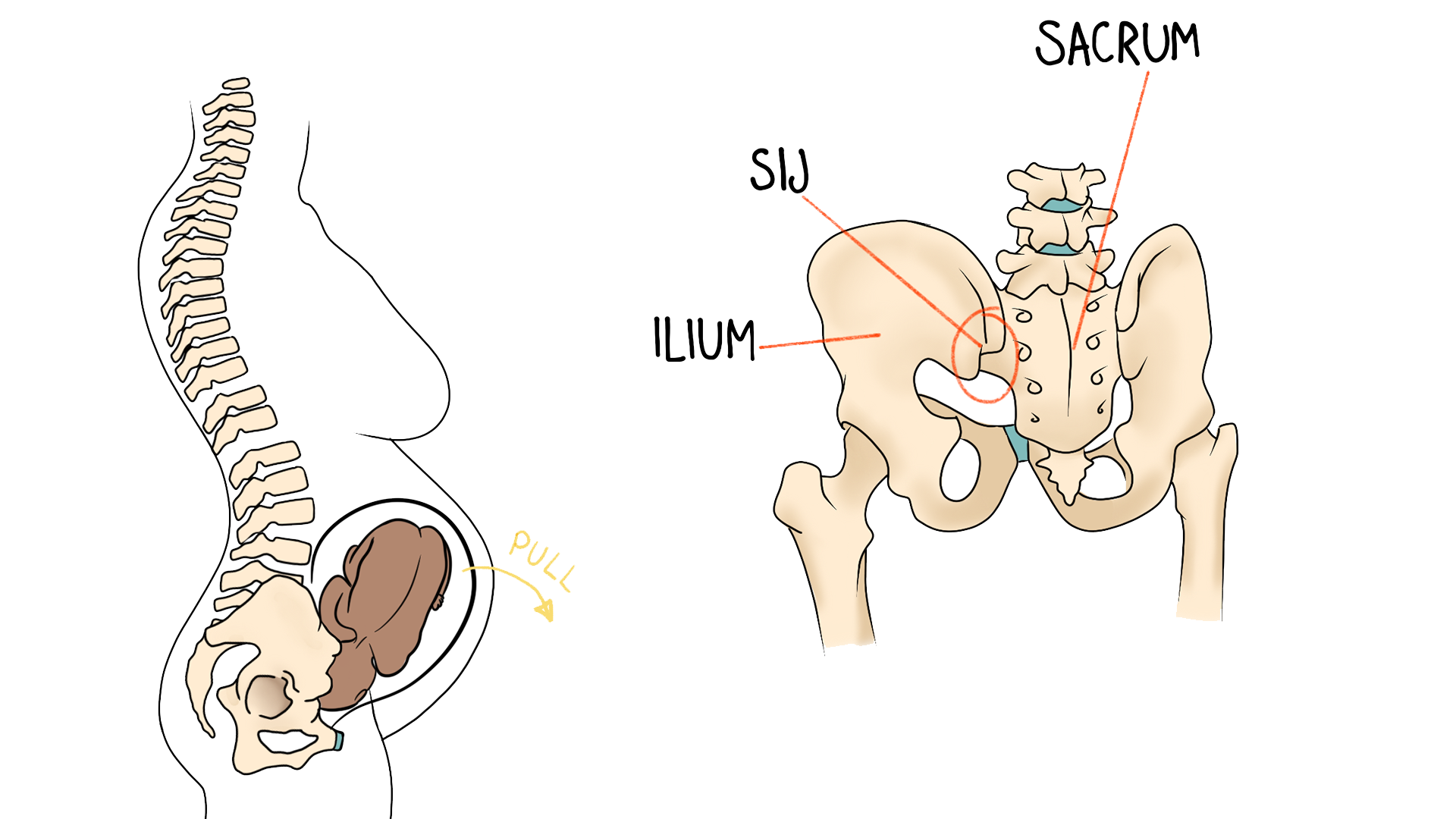
From early in pregnancy, your body produces a hormone called relaxin. It softens the ligaments of your pelvis — the structures that stabilize your sacroiliac joints at the back and your pubic symphysis at the front. This is preparation for birth. The pelvis needs some give.
But consider what's also happening alongside that.
Your belly is growing. Your center of gravity is shifting forward. Your pelvis is tipping . And now you have a situation where the joints of your pelvis are softer than they used to be, and they're being asked to carry more weight than before, in a position that isn't neutral.
The sacroiliac joints at the back are getting pinched by the added stress and tilt. And because your pelvis is tipping more than usual, weight isn't dropping straight down through a stable pelvis and into your legs. It's being pulled forward and down — right onto the pubic symphysis, a small 5mm joint that's already been softened by relaxin.
So of course your pelvis hurts. It's too much.
Relaxin is doing its job. You need it. The softening is appropriate and you can't change it.
But the pattern — the forward pull, the anterior tilt, the shifted center of gravity — that's something you can work with. Because you can work with how your pelvis is organized in relationship to the weight it's carrying.
Try something.
Find a chair with a hard, flat surface. Sit toward the front with your feet flat on the floor. Notice where you're feeling weight on your sitting bones — toward the front, the middle, or the back.
Based on experience, I would assume it's more toward the front.
Now think of your pelvis like a bowl of water. When it's in that forward tilt, you're spilling water out of the front of the bowl. See if you can gently find somewhere a little closer to the middle. Not tucking. Not forcing. Just finding a place where the water stays in the bowl.
You just changed the relationship between your pelvis, your spine, and the weight they're carrying. You may have felt a small touch of relief. That's your awareness making a real shift in how things are organized. And you can do that anytime.
Your belly will exert a constant forward pull, so anytime you can notice that and slightly shift your weight is a moment of relief for your pelvis.
To make that shift more than momentary — because you do have to actually get up out of the chair — you need to support the part of you that's pulling everything along with it. Your belly.
This is where your deep core comes in. Those muscles that wrap all the way around your torso, from your low back to the center line of your belly, and down to either side of your pubic symphysis. When they engage, they hug baby up and in and gently nudge your pelvis out of its anterior tilt.
Think about what that actually means for your joints. The weight that was dropping forward onto an already softened ligament — or pulling the sacroiliac joints behind with it — is now being supported. Lifted slightly. The pelvis finds a little more organization, a little more stability, under a changing load.
Not perfectly. Pregnancy is full of aches and pains. But it's meaningful to work with what you can.
Prenatal Core Connect is a seven-day course to relief from pain through connection to your deep core. Made specifically for low back pain, but often pelvic girdle pain and low back pain are often all mixed up. They're both expressions of the same thing. The link is below if you'd like to go through it.