
Sciatica in Pregnancy
Prenatal with Jaimi

The short version:
That shooting, burning, or radiating pain going down your leg is an irritated sciatic nerve. In pregnancy, it's not random — there's a predictable pattern behind it. The same one that's often behind pelvic girdle pain and low back pain. Learn to engage with your deep core and you can find relief.

If you're pregnant and you're feeling a shooting or burning pain that runs from your hip or glute down into your leg — that's sciatica.
And even though it's common in pregnancy, you don't have to suffer through it.
Sciatica is a symptom, not a diagnosis. It means the sciatic nerve is being irritated somewhere along its path — from the lower back, through the glute, and down the back of the leg. The pain, tingling, or numbness follows that route.
There are a few reasons the sciatic nerve can get irritated during pregnancy. But when you zoom out you realize that it follows a predictable pattern.
Your low back curves a little more than it used to. Your pelvis tips forward. Your ribs flare slightly. Everything reorganizes around the new weight in front of you.
This is the predictable pattern of pregnancy — your body doing what bodies do, adapting to a growing belly. And it creates something close to a perfect storm for sciatica.
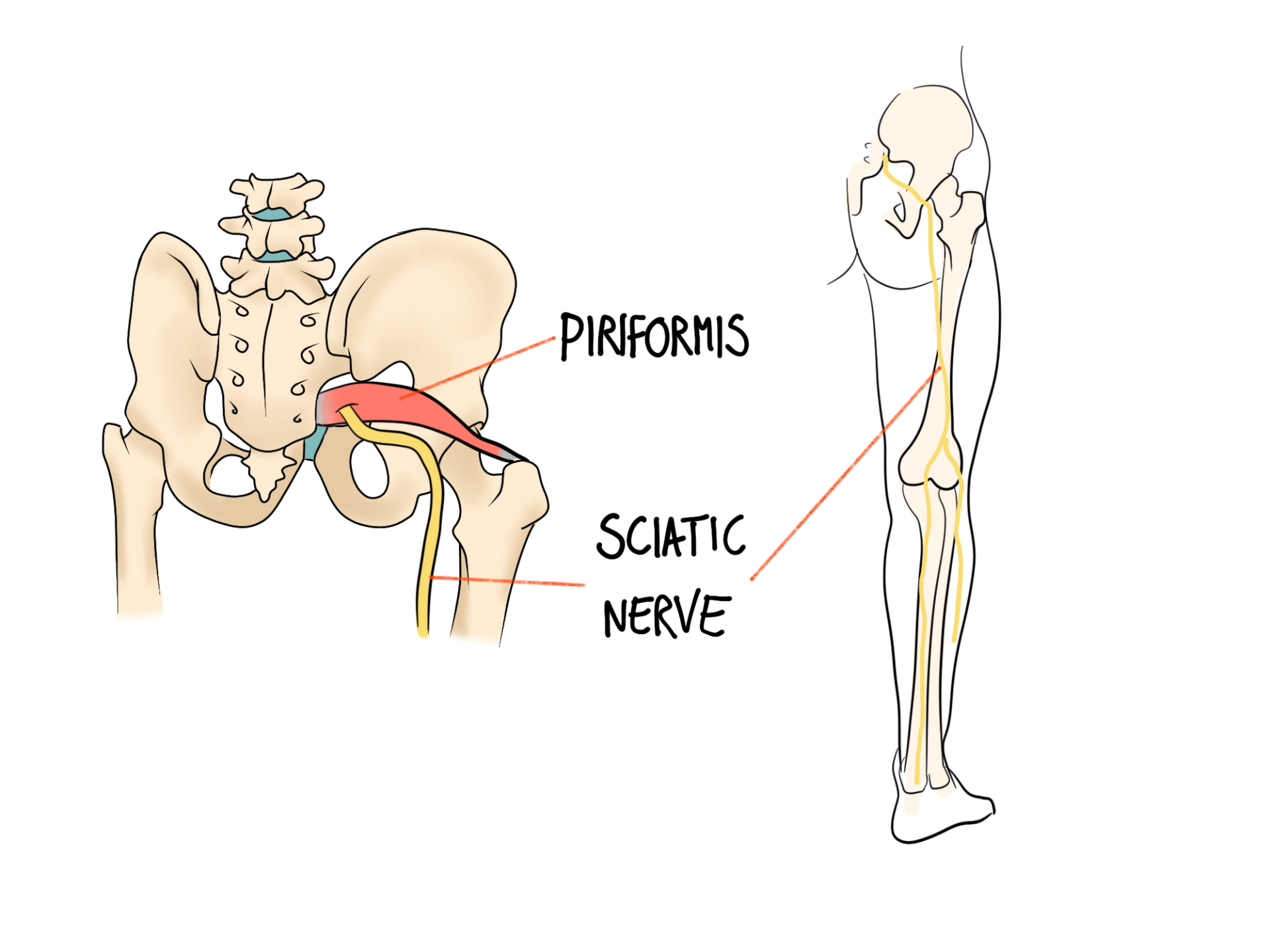
Think about the exaggerated curve at your low back. That curve changes how much space is available back there. The nerves that form the sciatic nerve exit the spine at the very bottom of your low back. When there's less room, there's more potential for irritation — things get a little pinchy.
Now look further down the pattern. The forward tip of the pelvis — anterior pelvic tilt — means your hip flexors are working hard, your glutes aren't working enough, and a small muscle deep in your glute called the piriformis ends up overworked.
Also, the sciatic nerve passes directly beneath, through, or around the piriformis.
So: a nerve already potentially compressed at the spine, now also being compressed by a muscle that can't get out of its own way. That's the storm.
What you can work with:
You can't stop your belly from growing. But you can change how your pelvis reltes to the weight it's carrying — and that changes the conditions for the nerve.
Try something.
Find a chair with a hard, flat surface. Sit toward the front with your feet flat on the floor. Notice where you're feeling weight on your sitting bones — toward the front, the middle, or the back.
Think of your pelvis like a bowl of water. When it's in that forward tilt, you're spilling water out of the front of the bowl. See if you can gently find somewhere a little closer to the middle. Not tucking. Not forcing. Just finding a place where the water stays in the bowl.
You just changed the relationship between your pelvis and the curve of your low back. The piriformis has a little more room. The nerve has a little more room. That's the pattern being worked with in real time.
And you can do that anytime. The forward pull is constant — which means the opportunity to notice and gently shift is constant too.
Taking it further:
To make that shift more than momentary, you can add support to the part of you that's pulling everything along with it.
Your belly.
This is where your deep core comes in. The muscles that wrap all the way around your torso — from your low back to the center line of your belly, like an intrinsic belly band — when you can gently engage with them in relationship to the pattern, a couple of things happen at once. The exaggerated curve in your low back eases. The pelvis has less reason to tip. And the piriformis isn't being asked to work so hard in a position it can't get out of.
The pattern comes with you everywhere — standing, sitting, walking, getting out of bed. What you need is an awareness that comes with you too.
Sciatica and low back pain in pregnancy are often mixed up — they're both expressions of the same predictable pattern. Prenatal Core Connect is a seven-day course that works through that pattern one layer at a time. The link is below if you'd like to go through it.
Prenatal Core Connect